.jpg)
The One Tool That Makes or Breaks a Weld: Your Guide to Choosing the Right Pipe Welding Clamp
Ask any experienced pipe welder what separates a clean, strong weld from a problematic one, and the answer usually isn't about skill or wire type. More often than not, it comes down to preparation — and specifically, how well the pipes were held in position before the arc was even struck.
A pipe welding clamp is one of those tools that doesn't get enough credit. It works quietly in the background, holding everything exactly where it needs to be, so the welder can focus entirely on the joint. But when it's the wrong clamp for the job — or when there's no clamp at all — the difference shows up immediately in the finished weld.
At Pipe Stands and Clamps, part of the SFE Group, this is exactly the kind of challenge the product range is built around. Whether you're working on a single-pass root run or a complex multi-joint fabrication, the right clamping setup matters more than most people realise.

What a pipe welding clamp actually does
The job of a pipe welding clamp sounds simple: hold two pipe ends together while you weld them. But the requirements beneath that simple description are quite specific. The clamp needs to bring the pipe ends into precise alignment, hold them at the correct gap, resist movement under heat, and release cleanly once the weld is complete — all without damaging the pipe surface.
Misalignment, even by a few millimetres, causes high-low defects at the joint. In industries like oil and gas, power generation, or chemical processing, those defects aren't just an aesthetic issue — they're a structural one. Clamps are what prevent them.
"The clamp doesn't make the weld. But without the right one, no amount of skill fully compensates for a joint that moved, shifted, or sat slightly off-centre before the first pass was completed."
Types of pipe welding clamps worth knowing
Not every clamp suits every application, which is why Pipe Stands and Clamps carries a range built for different working conditions and pipe specifications.
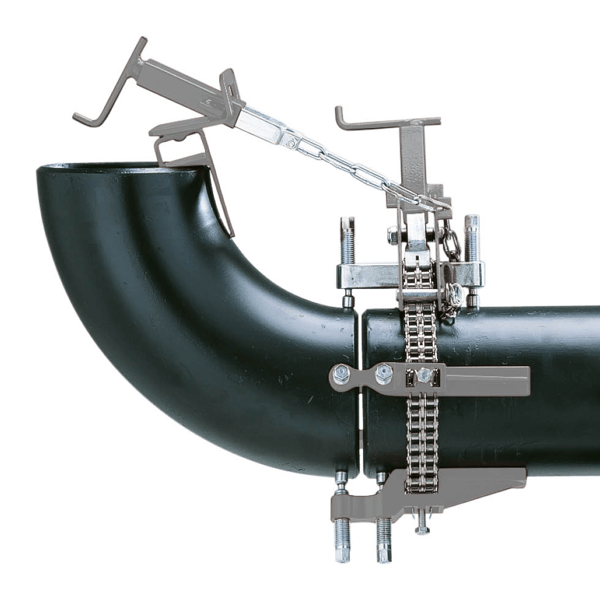
Pipe alignment clamps are the most commonly used type on fabrication sites. They grip around the outside of both pipe ends and draw them into alignment simultaneously, compensating for minor ovality or surface irregularities. They're fast to set up, adjustable, and work across a broad range of pipe diameters.
Cage clamps take a different approach. Rather than gripping at a single point, they distribute clamping force around the full circumference of the pipe. This makes them particularly effective on thin-wall pipe where localised pressure from a standard clamp could cause distortion — exactly the kind of problem that compounds during welding.
For larger diameter pipes or more complex fabrication setups, internal clamps are also worth considering, though the external alignment clamp remains the workhorse of most site operations for good reason: they're quick, reliable, and require no internal access to the pipe.
Understanding pipe purge systems — and why they go hand in hand with clamping
Once you have your pipe welding clamp set and your alignment confirmed, there's another critical step that often gets overlooked on less experienced sites: purging.

A pipe purge system removes oxygen from inside the pipe at the weld zone before and during welding. When stainless steel, titanium, duplex, or other reactive alloys are welded without purging, oxygen in the bore reacts with the heat of the weld and causes oxidation — commonly called sugaring — on the inner weld bead. The result is a weld that looks fine from the outside but is compromised on the inside, both structurally and in terms of corrosion resistance.
The way a purge system works is straightforward: inflatable pipe stoppers or purge dams are inserted into the pipe on either side of the weld zone, sealing off a small internal chamber. An inert gas — most commonly argon — is then fed into that chamber to displace all the oxygen before welding begins. Oxygen levels are monitored with a purge oxygen monitor until they reach the required specification, usually below 50 parts per million for critical applications.
Pipe Stands and Clamps supplies full pipe purging systems, purge oxygen monitors, and compatible pipe stoppers — so everything you need to run a compliant, clean weld is available in one place through the SFE Group.
Choosing the right setup for your application
The honest answer to "which pipe welding clamp do I need?" depends on several things: pipe diameter and wall thickness, material type, joint access, and whether you're working on a fixed fabrication or a site installation.
For most standard carbon steel pipework in construction or industrial maintenance, a good-quality external alignment clamp from the Pipe Stands and Clamps range covers the majority of situations. Add cage clamps for thin-wall or stainless applications, and a purge system for any weld specification that demands internal quality — which, increasingly, most do.
What the SFE Group range is built on is the understanding that welders and fabricators don't need more complexity. They need tools that do exactly what they're supposed to do, every time, without fuss. That's the thinking behind every product in the Pipe Stands and Clamps catalogue — from the simplest alignment clamp to a complete purging setup for a critical weld.
Getting the most out of your clamping setup
A few practical points worth keeping in mind on site: always check clamp jaw condition before use — worn jaws reduce clamping accuracy over time. Clean pipe ends before fitting the clamp, as debris can affect alignment. And when using a purge system alongside your clamp, allow sufficient purge time before welding; rushing this step is where most purge-related weld defects originate.
If you're unsure which combination of clamp, stand, or purging equipment suits your specific job, the team at Pipe Stands and Clamps is set up to help. SFE Group has been supplying professional welding and pipe fabrication equipment for years, and the technical knowledge behind the product range reflects that experience directly.
The right pipe welding clamp, paired with the right purge system, isn't an expense — it's what a quality weld is built on.


Comments